Friday, June 9, 2006

SENS scrutinized

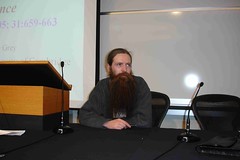
A couple of weeks ago I was walking with Aubrey de Grey in picturesque Palo Alto when I asked him what the latest word was on Technology Review’s SENS challenge. He looked at me quite seriously and said, “The first three submissions will be presented in just two days.” I asked him if he was worried, and he responded by noting that he was pleased with the selection of judges – a panel that includes Rodney Brooks and Craig Venter, among others.

If I was to read into de Grey’s answer, he was suggesting a certain degree of confidence in not just the integrity of SENS, but also in the judges’ ability to satisfactorily assess the nature of the contest.

For those who are a) interested in radical life extension and are b) living in a cave, Technology Review editor Jason Pontin offered a challenge last year to anyone who can demonstrably show that de Grey’s Strategies for the Engineering of Negligible Senescence “is so wrong as to be unworthy of learned debate.” Should a winner be declared, they would be the recipient of a US$20,000 prize. A group of judges was recently assembled to assess the entries and the first 3 challenges are now up for review.

I’ve read through the arguments, rebuttals and counter responses and have a number of things to say.

First, regardless of the outcome, it is extremely important that both de Grey and SENS be put under this kind of scrutiny -- even if the contest is a tad sensationalistic. If de Grey is guilty of propagandizing pseudoscientific beliefs and establishing a cultish personality around himself – and I am not suggesting that he is – it is important that this be considered and brought to the public’s attention. More importantly, however, the ad hominem that has in no small way characterized this contest has similarly got to be fleshed out and exposed; as Reason aptly pointed out in his Fight Aging review, “SENS is not de Grey.” This heated debate has brought out the worst in all parties as far as I’m concerned.

Indeed, cutting through all the noise to get at the substance has been difficult. The submission by Estep et al, for example, was thin on content and never short on criticisms of de Grey. At one point the authors compared de Grey’s ‘delusions’ to those of Lysenko’s and Velikovsky’s.

But once the wheat is separated from the chafe, the various arguments against SENS are complex and provocative:

Can microbial hydrolases be used to degrade intracellular aggregates that accumulate with age? How viable is mitochondrial engineering? Is SENS a strategy against symptoms rather than cures? Are there informational limits to the brain? Can the brain be reprogrammed for extreme longevity? Will medical science be able to keep up with all the unforseen problems of aging?

Open issues such as these are not just the concern of de Grey and his detractors, but also of speculative biologists, gerontologists, neurologists, and other scientists. Today, it’s not uncommon to see conferences, dissertations, and experiments directly addressing these various biological and medical issues.

Which brings up a very interesting point. By virtue of Technology Review’s SENS Challenge, and in consideration of the various arguments and counter-arguments, is this not already “learned debate?” Isn’t this very contest a blatant demonstration that the experts are in fact already debating the inner aspects of SENS? What kind of farce is this?

Perhaps I’m being facetious; I do realize, after all, that the contest is an attempt to exorcise SENS from scientific credibility. But at what point is it acceptable for scientists to denigrate opposing viewpoints by banishing their opponents and their ideas outright? Just what, exactly, is the intention of the contest organizers? Do they want to see de Grey disappear from the scene? Do they want all this anti-aging mumbo-jumbo to stop?

I'm reminded how bitter rivalries are the stuff of science. A quick roll-call includes Darwin v. Owen, Gould v Mayr, Haldane v. Mayr, Dawkins v. Gould, and Margulis v Dawkins.

This whole contest, it would seem, appears to be a rather bizarre forum for the peer review of SENS – or a desperate attempt to prevent de Grey from actually getting the chance for more formal peer review and, by virtue, increased academic credibility.

Or, more simply, this contest is just a personal battle between Jason Pontin and Aubrey de Grey. Ah, but let’s face it – it’s likely just a silly publicity stunt that will ultimately benefit Technology Review, the panel of judges, and Aubrey de Grey himself regardless of the outcome.

So, what will the judges decide? Is SENS truly unworthy of learned debate (excluding the very exercise of debating it for the purpose of the contest :-P). Well, there’s a better than excellent chance that SENS in its current incarnation is absolutely wrong. It’s very possible that the judges will concur with this possibility and rule against de Grey. What would be absurd, however, would be a declaration that the war against aging itself is an idea unworthy of debate.

To all you de Grey groupies on the edge of your seats in anticipation of The Big Decision, it's time to take a chill pill and a deep breath. The outcome of this contest will have no bearing on the work to come against the ravages of aging. A ruling by the judges against de Grey would have no bearing on anti-aging research, and would at worst cause de Grey to have to revise his strategy (or his approach). But he needs to do this anyway as SENS should at no time be considered a static document. Twenty years from now we may laugh at the naiveté of SENS, but I highly doubt we’ll laugh at the maturation of real anti-aging interventions that will have sprung from this seed of an idea.

When all is said and done (whatever that means), it may be that de Grey will have had very little to contribute to bona fide anti-aging advances (although I doubt that). De Grey will not cure aging by himself and any assertion that he will is patently ridiculous. The war against aging will be a concerted and protracted effort that will in all likelihood take many decades, numerous researchers and vast resources. Further, the efforts to halt the aging process will be the result of converging therapeutic interventions that will address aging related pathologies on an individualized basis. While an all-reaching overview like SENS is laudable and even practical, it will still come down to the specialists working on their focused aging related problems.

While de Grey may not be in the trenches, what’s undeniable is his work as an anti-aging pioneer who’s blazing an inspirational trail for future gerontologists. And cancer researchers. And neurologists. And anyone else who considers an aging related problem to be potentially solvable. De Grey is an archetype in the making.

So, my pre-interpretation of the judge’s decision should they vote against SENS is that they will likely take issue with the inner working of SENS and de Grey’s methodology. And as I said, on this point they may be right – an outcome that may cause de Grey to go back to the drawing board to come up with SENS 2.0. If they declare, however, that speculations into anti-aging interventions per se are “beyond learned debate,” then they will have made a significant judgemental error.

If, on the other hand, the judges vote in favour of SENS, it would represent a clear victory for those who continually push the boundaries of science into uncharted and controversial areas. It’s artist as scientist, drawing outside the lines to conceive of new possibilities and charting all the terra incognita. Perhaps this is why de Grey is happy with the current set of judges; like himself, the panel is filled with visionaries and big thinkers.

But is this more philosophy than science? Indeed, a part of me thinks that de Grey is more philosopher than anything else, but I also realize that philosophers ain’t what they used to be. Take Daniel Dennett, for example – a new breed of thinker who is equal parts philosopher and scientist. It’s a fair question to ask, at what point does philosophy graduate to science? Is SENS already at the stage where it’s a testable, refutable strategy? How about Eric Drexler’s projections for molecular assembling nanotechnology? Is that also outside the boundaries of learned debate? What about theoretical physics and quantum mechanics? Do these questions even matter in the context of deciding whose ideas deserve 'learned debate' and those whose don’t?

There’s no question that de Grey’s strategy is out there. It's dependant on vapourware, broad extrapolations, and several leaps of faith. At the same time I can accept the fact that his timelines may be overly optimistic, his interventions incomplete, and that he may be underestimating the complexities of aging.

But longer timescales, incompleteness and complexity do not imply intractability – and this is what de Grey’s detractors have failed to comprehend.

I think it’s obvious that de Grey is on to something.

Tags: , , , , , .

Bukowski on aging radicals

I like this poem by Charles Bukowski called, "having the flu and with nothing else to do."
I read a book about John Dos Passos and according to
the book once radical-communist
John ended up in the Hollywood Hills living off investments
and reading the
Wall Street Journal

this seems to happen all too often.

what hardly ever happens is
a man going from being a young conservative to becoming an
old wild-ass radical

however:
young conservatives always seem to become old
conservatives.
it's a kind of lifelong mental vapor-lock.

but when a young radical ends up an
old radical
the critics
and the conservatives
treat him as if he escaped from a mental
institution.

such is our politics and you can have it
all.

keep it.

sail it up your
ass.

Thursday, June 8, 2006

Jobs change

As I review this list of mid 19th century jobs in London, England I marvel at the effects of constant technological change on the nature of the workplace:

168,701 domestic servants.
29,780 dressmakers and milliners.
28,574 boot and shoemakers.
21,517 tailors and breechesmakers.
20,417 commercial clerks.
18,321 carpenters and joiners.
16,220 laundrykeepers, washers, and manglers.
13,103 private messengers and errand boys.
11,507 painters, plumbers, and glaziers.
9,110 bakers.
7,973 cabinetmakers and upholsterers.
7,151 silk manufacturers, (all branches).
7,002 seamen.
6,741 bricklayers.
6,716 blacksmiths.
6,618 printers.
6,450 butchers.
5,499 booksellers, bookbinders, and publishers.
4,980 grocers and teadealers.
4,861 tavernkeepers, publicans, and victuallers.
4,290 clock and watchmakers.

Jobs come and go. Entire industries come and go. And the sentiments and politics surrounding these rapid changes struggle to keep up. People try to fight the fact that demand for certain jobs disappear over time. Political parties, such as the NDP in Canada, struggle to remain relevant in an increasingly post-industrial world.

But is the quality of jobs improving? For the most part, yes, as jobs are less physically demanding and dangerous than they have been in the past. Where there might be a problem is in how desk jobs are mind-numbingingly repetitive and physically un-demanding. I don't think the human body fares very well in such sedentary conditions. No wonder coffee is so popular at the workplace; I for one am dependant on its stimulant properties.

With accelerating change in effect, it should be interesting to see the fleeting nature of certain jobs and industries in the coming decades.

Friday, June 2, 2006

Constructing the case for enhancement at Stanford

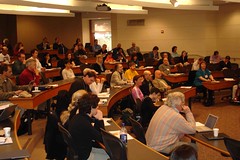
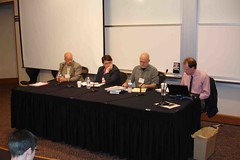
This past weekend I had the opportunity to attend and speak at the Human Enhancement Technologies and Human Rights (HETHR) conference at Stanford University in Palo Alto, California. The conference, which was sponsored by the Institute for Ethics and Emerging Technologies (IEET), the Center for Cognitive Liberty and Ethics (CCLE), and the Stanford Law School (SLC), brought together a diverse array of thinkers who spent the weekend ruminating over the challenging issues surrounding human enhancement.

The central focus of the conference was to construct a case for human enhancement based upon the lofty principles of human rights, liberalism and bodily autonomy. The event was in no small way a direct challenge to the burgeoning anti-enhancement camp that has arisen in recent years to combat what is perceived to be a threat to human dignity and humanity itself. Organizers of HETHR hoped that the conference would demonstrate that a viable and compelling case could be made in favour of enhancement. Based on what I heard at the event, I would say it was mission accomplished.

First, the caliber and credentials of the speakers was excellent – one of the strongest set of panels and panelists I've yet seen at such a conference. Attendees and speakers came from as far away as Australia and Europe and were comprised of academics, activists, journalists and the curious. And tellingly, the conference crowd was a fair mixture of men and women, young and old, and included some visible minorities – a far cry from the young white male crowd that came to dominate similar events only a few years ago.

Second, the arguments and legal frameworks supporting the issue of biotechnological enhancement are most certainly beginning to crystallize and take root. The human enhancement debate is in the process of maturing – a development that will end with the normalization of enhancement discourse in bioethics circles and eventually within society itself. As evident throughout the conference, the ethical and legal frameworks necessary to uphold human rights and enable the responsible development and application of enhancement technologies are very much under construction.

Such a conference would have been unlikely only a few years ago. Quite obviously, issues surrounding changes to human reproduction, morphology and cognition are highly contentious -- a swarm of sensitive issues that has thrown traditional left-right politics completely off kilter. As Reason science correspondent Ronald Bailey noted during his presentation, our pending transition to a self-modifying species will be the key political issue of the 21st century.

But while the HETHR conference was a definite step forward, it almost never happened.

Just prior to the event word got out to the Stanford brass that an enhancement themed conference was to be held at the Law School. They reacted by trying to shut it down. I suspect that the Stanford folk were not only wary of a potential 'crank' factor (the Singularity Summit was similarly unjustly singled out two weeks prior), but of the sensitive subject matter as well.

But it was through the diligent and persuasive lobbying of conference organizer Henry Greely, the director of the Stanford Center for Law and the Biosciences, that the conference was allowed to continue. Techprogressives can be thankful that it did, as a cancelled conference would have been a decisive victory for the bioconservative camp.
Correction: I've been receiving responses from people involved and it looks like this was never the case. Both the Singularity Summit and HETHR conference, it seems, were never in any real danger of being cancelled, but they both faced tougher than ususal scrutiny.

Clearly affected by the hard struggle to keep the conference alive, Greely’s introductory talk was a plea for people to remain open-minded and to respect the freedom of academic discourse no matter how controversial the subject matter might initially appear to be.

Once the conference got underway it was obvious that the participants took heed of Greely's words. What followed over the course of the weekend was a spirited and tolerant atmosphere in which attendees did not have to feel shackled by stifling political correctness, established ethical and philosophical conventions, or constraining visions of the future.

Moreover, by giving the three key sponsors an equal opportunity to mould the event, HETHR never came to be dominated by any one set of priorities or visions. For example, members of the IEET, a techprogressive think-tank run by bioethicist and HETHR organizer James Hughes, provided the decidedly future-tech perspective. This angle was tempered by the groundedness of the Law School and by the activistic and socially hip work of the CCLE -- a group directed by the charismatic duo of Wrye Sententia and Richard Boire. Consequently, the presentations were in tune with some of the more profound implications of pending GNR technologies (e.g. radically extended lives, AI, virtual persons, animal uplift, etc.), while intermixed with the practical realities of law, politics and civil rights.

The conference, then, was never dominated by the technorapturesque mood that has come to characterize similiar events. It was truly a conference for ethicists by ethicists – many of whom were openly critical and frustrated with their own departments and with what they have come to perceive as the unrealistic and flawed bioconservative streak that comprises a significant part of mainstream bioethics today.

Indeed, the conference itself was an amazing showcase for ethical discourse. Panelists reached deep into their methodological tool kits to find support for their various cases; names that consistently rang out throughout the conference included Plato, Aristotle, Socrates, Aquinas, Kant, Locke, Rawls and Singer. Key ethical concepts and concerns that were regularly tossed into the fray included issues of egalitarianism, utilitarianism, contractarianism, cultural relativism and even Buddhism and transhumanism. Debates centered around issues of primary versus positional goods, therapy versus enhancement, identity and authenticity, what it means to be 'normal', liberty, justice and human rights itself. Even those ethicists critical of human enhancement, including William Hurlbut and Nigel Cameron, refrained from regressing to tired conservative and religious arguments, instead opting to directly challenge and critique the various pro-enhancement positions; it was dialog rather than shouting, debate rather than hysteria.

Among the many highlights of the conference, a poignant moment came during Walter Truett Anderson's presentation. Anderson, a forward thinking enviro-realist, reminded the audience that as we stand at the eve of human enhancement the body is still a system that operates within a larger system. Part of the coming challenge, he argued, is to look at human enhancement in the context of the environment and the planet itself.

At the same time, however, Anderson also issued a challenge to traditional environmentalists. Quoting environmentalist pioneer George Perkins Marsh, he noted that "humans change things.” This observation, he said, is very much a part of the human condition. It's a lesson that Anderson believes most environmentalists have yet to learn. In this increasingly networked age, and as the planet becomes progressively wired along with it, environmentalists must realize that humanity cannot enforce a hand's off policy with regards to the planet. Whatever environmental aspect is altered and managed on Earth, it will be the result of our guiding hands. Such changes will be indistinguishable from what we consider to be 'natural' today. Anderson declared that we are poised to deliver the planet into its next phase of evolution.

The analogy to human enhancement and our increasing control over the 'human system' was not lost on the audience. Indeed, contrary to what many bioethicists would have, we cannot expect to exert a hand's off policy to the human body. Yes, humans change things. They change the environment. They will change themselves.

Like our approach to the environment, the changes that we will make to ourselves will eventually prove to be both desirable and necessary. And like the future of Earth, it will represent the next phase in our own evolution.

In the meantime, conferences like HETHR will serve as the sounding boards and springboards to a prosperous, fulfilling and dignified future for all.