Wednesday, July 12, 2006

Global warming and the end of human freedom

Humans and human institutions are clearly failing the planet.

And when environmental catastrophes finally hit the tipping point, panicked societies will start to fail humanity itself. Preventing global warming, it would seem, is not just about preserving the biosphere, it’s also about preserving human freedom.

At the recent IEET conference at Stanford University, environmentalist Walter Truett Anderson declared that global warming is the single most important problem to ever face humanity. In a history dominated by everything from plagues to genocide, that's a rather bold statement to make, and likely very true.

So, why aren't we mobilizing en masse to deal with the crisis? Why isn’t it the first thing we think about when we wake up and the last thing before bed? The reasons are frustratingly multifaceted--a long list that includes such factors as corporatist indifference (think of the Kyoto failure), a population largely ignorant and in denial, and an insufficient sense of crisis. The sky, after all, is not falling...at least not yet.

Another reason is the democratic and libertarian streak that now permeates all liberal societies. Rather than state coercion, people are expected to act voluntarily and to democratically establish institutions that will contend with problematic issues like global warming. The general assumption is that people tend to be intelligent, reasonable and self-preserving. Give them a good reason to act and they will do so out of their own volition.

Unfortunately, as the global warming issue has revealed, this tendency has not been put into practice to any great extent. SUV’s and Hummers dominate the streets, factories churn out the pollutants, and country after country fail the minimum requirements established by Kyoto—with other countries either not participating or threatening to pull out altogether (like Canada, for example).

Sadly, the only time in human history when people have been effectively mobilized for mega projects is when a state declares war on another, or when the state declares war on its own citizens (as witnessed by authoritarian dictatorships or totalitarian fascism, communism and theocratism). I don’t use these examples lightly. They reveal disturbing insights into human behavior and selfishness, the inefficacy of political and corporate institutions, and ultimately, the role of state coercion throughout human history. In the case of war and totalitarianism, they are political phenomenons that are both emblematic and driven by feelings of desperatism. Under these conditions, populations are compelled by their governments to fanatically work towards desired ends. And these ends, of course, trump such niceties as human liberty.

Sure, there’s no seemingly obvious reason for alarm or desperatism today—-but it’s not implausible to suggest that quai-totalitarian frameworks will arise as a result of the calamitous effects of global warming. Once the environment truly goes to hell and it becomes overtly obvious that a catastrophe is actually happening, our respective governments will find ways to a) control its fearful populace, and b) compell its citizens to live and work a certain way. It would be George Orwell on hydraulic despotism.

Such state prerogatives may come about through democratic processes—governments elected out of fear and panic. Or, these political regimes may arise from unilateral political action (a la the current Bush regime; as American libertarians are finally learning, when times get tough, the liberties get going). Regardless, they will morph into governments driven by a frantic and panicked call to action.

So, along with the environment, it’ll only be a matter of time before you can kiss your free ass good bye.

Tags: , , , , , .

Gone to that great gig in the sky

Syd Barrett, 1946-2006.

Lime and limpid green, a second scene
A fight between the blue you once knew.
Floating down, the sound resounds
Around the icy waters underground.
Jupiter and saturn, oberon, miranda and titania.
Neptune, titan, stars can frighten.
Lime and limpid green, a second scene
A fight between the blue you once knew.
Floating down, the sound resounds
Around the icy waters underground.
Jupiter and saturn, oberon, miranda and titania.
Neptune, titan, stars can frighten.
Blinding signs flap,
Flicker, flicker, flicker blam. pow, pow.
Stairway scare dan dare whos there?
Lime and limpid green, the sounds around
The icy waters under
Lime and limpid green, the sounds around
The icy waters underground.

Tuesday, July 11, 2006

Wikipedia, postgenderism and me

I found out today that the postgenderism entry on Wikipedia was deleted and a new re-direct set up in its place that points to the wiki entry on me, George Dvorsky.

That's completely weird and unexpected. I'm not necessarily thrilled with having a philosophical or social movement essentially equated with my name on Wikipedia. Moreover, it's hardly emblematic of my work and writings in futurism and transhumanism in general.

It's my understanding that the reason for shutting down the discrete 'postgenderism' entry was due to a lack of citations and other examples of expositions on the matter (other than my own). I'm not convinced that's entirely fair. Other people did contribute to the postgenderism wiki entry, and citations were made to such thinkers as Donna Haraway.

Well, we'll see how the entry evolves over time. I'm inclined to stay out of it and watch what happens. It's also about time that I write a formal paper on the matter and submit it to a journal like JET. But first things first -- I'm still working on my animal uplift paper.

SENS survives Pontin's challenge

Not surprisingly, at least not for me anyway, Aubrey de Grey's "Strategies for Engineered Negligible Senescence" (SENS) survived a Technology Review challenge which sought to determine whether or not the theory was worthy of "learned debate."

Here's a nice summation of the judge's conclusion:
We need to remember that all hypotheses go through a stage where one or a small number of investigators believe something and others raise doubts. The conventional wisdom is usually correct. But while most radical ideas are in fact wrong, it is a hallmark of the scientific process that it is fair about considering new propositions; every now and then, radical ideas turn out to be true. Indeed, these exceptions are often the most momentous discoveries in science.

SENS has many unsupported claims and is certainly not scientifically proven. I personally would be surprised if de Grey is correct in the majority of his claims. However, I don't think Estep et al. have proved that SENS is false; that would require more research. In some cases, SENS makes claims that run parallel to existing research (while being more sensational). Future investigation into those areas will almost certainly illuminate the controversy. Until that time, people like Estep et al. are free to doubt SENS. I share many of those doubts, but it would be overstating the case to assert that Estep et al. have proved their point.
Here's TR editor-in-chief Jason Pontin's account of the judge's findings.
Here's the Estep et al. dissention to the decision.
Read more about it in ImmInst and Betterhumans.
And here's my rant from a few weeks back.

Monday, July 3, 2006

Superman’s return to a post 9/11 world

I have a real soft spot for the 1978 version of Superman, so it was with some anticipation that I went to see Superman Returns yesterday with my eldest son – who is practically the same age now as I was back in ’78. After sitting (and often squirming) through the 2½ hour updated version, let’s just say that Superman Returns didn’t have nearly the same impact as its predecessor. It was actually quite mediocre, but it’s given me some fodder for a rant.

Like most of my reviews, this one is spoiler ridden, so stop reading now if this poses a problem for you.

Superman Returns is a curious movie in that it is more a re-imagining of the 1978 version than an amalgamation of previous versions or a completely revised approach along the lines of what Christopher Nolan recently did with the Batman franchise. A number of stylistic and plot elements from the 1978 film were retained, including aspects like Lex Luthor’s attempt to profit from a massive land grab and even the crystalline Fortress of Solitude itself. That said, the writers did alter the canon to a significant degree by having Superman return from a five year space mission in a failed attempt to find any remaining survivors of Krypton, and most surprisingly, the revelation that he has a son – one who looks to be endowed with similar powers.

Superman’s return from his five year hiatus is a key theme in the movie. Disappearing from the world without so much as saying good-bye, Superman’s return is met with mixed emotions, particularly by one Lois Lane who has since married and formed a family. In fact, Lane is set to receive a Pulitzer Prize for a shocking editorial titled, “Why the World Doesn’t Need Superman.” Lane and the inhabitants of Earth, it would seem, have come to grips with Superman’s absence and have learned to cope without their savior; indeed, Lane’s bitter piece was fueled by an existentialist sense of unfair abandonment and could have very well been titled, “Why the World Doesn’t Need God.”

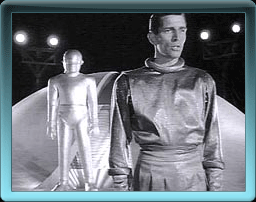
At first I was puzzled by the script writer’s decision to have Superman gone for so long, but the reason eventually dawned on me. Five years. Not an arbitrary number when you realize that we are quickly approaching the five year anniversary of 9/11. Like the arrival of the extraterrestrials in The Day the Earth Stood Still, Superman’s return is a quasi-messianic example of wish fulfillment in popular culture. Five years after 9/11, and deeply intertwined in the so-called war on terror, Americans are most assuredly looking to the sky for help.

In The Day the Earth Stood Still, aliens Klaatu and Gort arrive to 1951 Earth in an attempt to rescue a civilization that had only recently come into possession of apocalyptic weapons. Given the trauma of World War II, the rise of the Cold War, and the loss of innocence wrought from the development of planet destroying technology, nervous audiences were offered some (fictional) hope by having (fairly) benign creatures fall from the sky to set things right. God, it appears, was dead -- even in the 50s; if aliens couldn’t save us, after all, then who would?

And like the arrival of Klaatu and Gort, the return of Superman in 2006 is also reflective of contemporary geopolitical concerns and desperatism. When Christopher Reeve donned the red cape back in the late 70’s, Superman had to address the disturbing rise of urban violence and crime. Today, the stakes are much higher. With the United States under the perceived threat of super-terrorism, and with an incompetent and largely ineffective government in place to deal with the issue, defeatism has led to to those hopes that can only be realized in religious or science fictional outlets.

One could interpret the work of Superman, who works for truth, justice and the American way, as an analogy and rationalization of the geopolitical aggressiveness of the United States. Superman Returns can also be seen as a metaphor or craving for religious messianism, or simply as an example of escapism and wish fulfillment. Those partial to religious sensibilities will most certainly sympathize with the messianic overtones. Lois Lane, embarrassed by her earlier lack of faith, eventually decides to pen a new editorial -- this time making a case for “Why the World Needs Superman.” Or is that God? It’s Superman Returns as a call to prayer.

Alternately, given the fact that Superman doesn’t exist in our reality, one wonders if the film is making a case for passivity, despair and escapism. Given the hopelessness of the current geopolitical situation, are we better off disengaging from reality and slipping into dreamy Hollywood diversions?

I certainly hope not. Other post 9/11 science fiction franchises have taken a different approach. Battlestar Galactica, for example, has a decidedly West Wing element to it. The show is hard-edged, cynical and at times maudlin, but more representative of current realities than movies like Superman Returns.

Well, the kid in me that marveled at Superman in 1978 is most certainly dead, replaced by a thirtysomething sensibility that’s now easily irritated by simplistic and opportunistic pop culture drivel. But even if my tolerance for mindless distractions has withered over the years, it still doesn’t hide the fact that Superman Returns is a crappy movie. This film, while desperately trying to retain the majesty of Superman: The Motion Picture – it usurped the old musical score and Marlon Brando’s performance – utterly failed to incorporate the charm, poignancy, and depth of its forerunner.

And worse, by unabashedly making this a post 9/11 wish fulfillment movie, its creators have pandered to one of the more pathetic elements of American society and human nature itself.

Tags: , , , .