For those in the greater Toronto area, the Toronto Transhumanist Association will be hosting an introductory talk to transhumanism on Wednesday March 22, 2006 at 7:00 PM. The meeting will be held at OISE (Ontario Institute for Studies in Education), 252 Bloor St. West - Rm. 2227 (on the second floor).
I will be giving a brief introductory talk about the WTA, the TTA, and transhumanism in general. At the close of the meeting we'll be having an informal meet-and-greet.
Hope to see you there!
George Dvorsky
President
Toronto Transhumanist Association

Wednesday, March 22, 2006

Tuesday, March 21, 2006
The perils of miniaturization on the battlefield
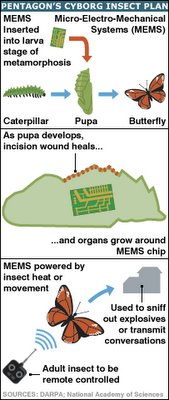 DARPA, the advanced concepts research group voted most likely to destroy the Earth, has come up with a bizarre futuristic idea for the Pentagon.
They want to create an army of cyber-insects that can be remotely controlled to check out explosives and send transmissions. The organisms would truly be cybernetic; the idea is to insert microelectromechanical systems (MEMS) at the pupa stage, when the insects can integrate them into their body, so they can be remotely controlled later.
A number of experts are skeptical, but it sounds fairly plausible to me. Most criticisms of the plan have to do with the supposed implausibility of creating such small MEMS. Indeed, today it is quite impossible, but the miniaturization revolution is in full swing, and it's likely that MEMS will eventually be manufactured that are small enough to fit inside the insect at the pupa stage.
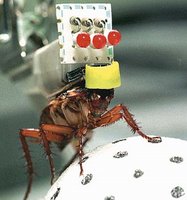 Moreover, scientists have already created cyborg roaches that have had their nervous systems tapped into. A research team at Tokyo University is making 'cyber-roaches' by lopping off the antennae of regular cockroaches and replacing them with pulse-emitting electrodes. The researchers then send signals with a remote control to a backpack worn by the roach that powers the electrodes. The roaches can be told to go left, right, forward and back.
This is starting to become something of a trend. It was rumored at one time that either China or the United States was developing nano-ants for the purpose of destroying the enemy's infrastructure. While somewhat outlandish, it does bring to mind the evil potential for robotic locusts and other man-made blights.
Indeed, these are dangerous precursors to nanoweaponry and other forms of advanced bioweapons.
Süddeutsche Zeitung Online recently featured an article about the potential for nanotech-equipped soldiers -- namely smart dust, self-healing body armor and self-reproducing nanobots.
Some analysts, including Jürgen Altmann, are starting to think that arms control needs to be extended to miniature weaponry. In his book, Military Nanotechnology: Potential Applications and Preventive Arms Control, Altmann takes a look at the prospect of future weapons and considers international security, the new dangers for arms control and the international law of warfare, the dangers for stability through potential new arms races and proliferation, and of course, the dangers to humans and human civilization altogether.
The specific technologies that Altmann considers include extremely small computers, robots, missiles, satellites, launchers and sensors, lighter and more agile vehicles and weapons, implants in soldiers’ bodies, metal-free firearms, autonomous fighting systems, and new types of chemical and biological weapons.
Thinking it through, Altmann concludes that international treaties need to be installed, existing non-proliferation agreements need to be extended, and that a general ban on autonomous robots smaller than 20 centimeters needs to be put into force.
But as the actions of the United States has recently shown, it is a country that is not very interested in these types of constraints. Back in 2000 George W. Bush pulled out of the Biological Weapons Convention, and in 2003 he withdrew the US from the 1972 Anti-Ballistic Missile treaty with Russia. And as the illegal (civil)war in Iraq continues, and as DARPA looks to litter the battlefield with cyber-insects, the chances of attaining global consensus on the regulation of miniaturized weapons looks slim indeed.
Tags: cybernetics, advanced weapons, darpa, nanoweapons, arms control, foresight, disaster prevention, future warfare.
 post to del.icio.us
Rushkoff, Kurzweil to be on CNN special
IEET fellow Douglas Rushkoff was recently recorded for a CNN special called Welcome to the Future, along with Jeff Greenfield, Ray Kurzweil, Mirka De Arellano, and Margaret Cho. The program will air on CNN Saturday March 25 at 7pm EST, and will be repeated Sunday at the same time.
Rushkoff has an account of the experience on his blog. Here's an excerpt:
Rushkoff has an account of the experience on his blog. Here's an excerpt:
It was a strange and long journey into various utopian and dystopian high-tech scenarios concerning everything from nano-bots implanted in two-year-olds so they can compete for places at increasingly selective nursery schools to why we never got to ride go carts on Mars even though Lost in Space was set in 1997.Tags: douglas rushkoff, ray kurzweil, futurism, human enhancement, human genetics, transhumanism.
I found Kurzweil brilliant but a little creepy. I'm usually on the gung-ho pro-technology side of discussions, so it was fun to be voicing some of the more cautionary concerns for a change. Of course, I've never really been pro-tech or anti-tech - just pro "life" (in the living things sense) and pro consciousness. While Mirka would argue against, say, genetic selection techniques on religious grounds (we should raise the children as God gave them to us), I was in the interesting position of suggesting how a balance could be struck between human agency and new technology. Do we *want* to choose our child's talents? If so, what does that say about why we want to have a child in the first place? Is it to have the opportunity to care for another human being, or simply to extend our own obsessions to another generation?
It all came down to "human nature" for Jeff Greenfield; you know, the idea that we can develop all sorts of technologies but human nature will stay the same, and use them for the same good and bad reasons. And that's when, for me, it became about the opposite: yes, human beings may have their biases, but so do the technologies we develop and implement. And we don't always know those biases when we set out to invent this stuff in the first place.
Civilized Life in the Universe
 Civilized Life in the Universe: Scientists on Intelligent Extraterrestrials
by George Basalla
Book Description:
This book is a selective and fascinating history of scientific speculation about intelligent extraterrestrial life. From Plutarch to Stephen Hawking, some of the most prominent western scientists have had quite detailed perceptions and misperceptions about alien civilizations: Johannes Kepler, fresh from transforming astronomy with his work on the shape of planetary orbits, was quite sure alien engineers on the moon were excavating circular pits to provide shelter; Christiaan Huygens, the most prominent physical scientist between Galileo and Newton, dismissed Kepler's speculations, but used the laws of probability to prove that "planetarians" on other worlds are much like humans, and had developed a sense of the visual arts; Carl Sagan sees clearly that Huygens is a biological chauvinist, but doesn't see as clearly that he, Sagan, may be a cultural/technological chauvinist when he assumes aliens have highly developed technology like ours, but better.
Basalla traces the influence of one speculation on the next, showing an unbroken but twisting chain of ideas passed from one scientist to the next, and from science to popular culture. He even traces the influence of popular culture on science--Sagan always admitted how much E. R. Burroughs' Martian novels influenced his speculations about Mars. Throughout, Basalla weaves his theme that scientific belief in and search for extraterrestrial civilizations is a complex impulse, part secularized-religious, and part anthropomorphic. He questions the common modern scientific reasoning that life converges on intelligence, and intelligence converges on one science valid everywhere. He ends the book by agreeing with Stephen Hawking (usually a safe bet) that intelligence is overrated for survival in the universe, and that we are most likely alone.
Tags: books-non fiction, book reviews, seti, life on other planets, astrobiology, astrosociobiology, fermi paradox.
Sunday, March 19, 2006

Subscribe to:
Posts (Atom)