
Thursday, August 26, 2010
Singularity Podcast interview now available
I was recently interviewed by Nikola Danaylov for the Singularity Podcast. You can listen to it here.

Matt Ridley: Criticism
A Sentient Developments reader directs our attention to this deliciously scathing review by George Monbiot of Matt Ridley and his work:
He uses [Rational Optimist] it as a platform to attack governments that, among other crimes, "bail out big corporations". He lambasts intervention and state regulation, insisting that markets deliver the greatest possible benefits to society when left to their own devices. Has there ever been a clearer case of the triumph of faith over experience?More.
Free-market fundamentalists, apparently unaware of Ridley's own experiment in market liberation, are currently filling cyberspace and the mainstream media with gasps of enthusiasm about his thesis. Ridley provides what he claims is a scientific justification for unregulated business. He maintains that rising consumption will keep enriching us for "centuries and millennia" to come, but only if governments don't impede innovation. He dismisses or denies the environmental consequences, laments our risk-aversion, and claims that the market system makes self-interest "thoroughly virtuous". All will be well in the best of all possible worlds, as long as the "parasitic bureaucracy" keeps its nose out of our lives.
His book is elegantly written and cast in the language of evolution, but it's the same old cornutopian nonsense we've heard one hundred times before (cornutopians are people who envisage a utopia of limitless abundance). In this case, however, it has already been spectacularly disproved by the author's experience.
The Rational Optimist is riddled with excruciating errors and distortions. Ridley claims, for instance, that "every country that tried protectionism" after the second world war suffered as a result. He cites South Korea and Taiwan as "countries that went the other way", and experienced miraculous growth. In reality, the governments of both nations subsidised key industries, actively promoted exports, and used tariffs and laws to shut out competing imports. In both countries the state owned all the major commercial banks, allowing it to make decisions about investment.
Matt Ridley is the Rational Optimist
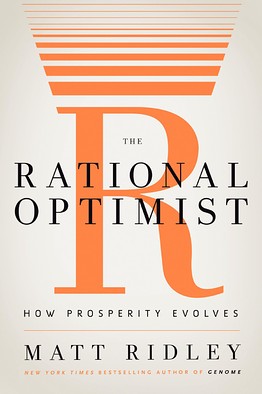 Matt Ridley published a book earlier this year called, The Rational Optimist: How Prosperity Evolves. There's some good ammo in here for those futurists who are regularly accused of having too many starry eyed visions of what tomorrow holds—and for those who simply believe that the human condition is steadily improving.
 Throughout history, says Ridley, the engine of human progress has been the meeting and mating of ideas to make new ideas. It's not important how clever individuals are, he argues, what really matters is how smart the collective brain is.
As an aside, and not that this is his particular argument, the notion of the 'collective brain' being superior to the super-enhanced human or artificial brain is an idea that's starting to gain some currency in futurist circles. Some argue that base intelligence doesn't matter. Rather, it's the collectivity of ideas that gives human civilization its power. I'm not quite sold on this premise, but it's certainly worth considering; I certainly recognize the realization that we are standing on the shoulders of giants.
Promo blurbage:
Life is getting better—and at an accelerating rate. Food availability, income, and life span are up; disease, child mortality, and violence are down — all across the globe. Though the world is far from perfect, necessities and luxuries alike are getting cheaper; population growth is slowing; Africa is following Asia out of poverty; the Internet, the mobile phone, and container shipping are enriching people’s lives as never before. The pessimists who dominate public discourse insist that we will soon reach a turning point and things will start to get worse. But they have been saying this for two hundred years.The WSJ recently published an excerpt from his prologue:
Yet Matt Ridley does more than describe how things are getting better. He explains why. Prosperity comes from everybody working for everybody else. The habit of exchange and specialization—which started more than 100,000 years ago—has created a collective brain that sets human living standards on a rising trend. The mutual dependence, trust, and sharing that result are causes for hope, not despair.
This bold book covers the entire sweep of human history, from the Stone Age to the Internet, from the stagnation of the Ming empire to the invention of the steam engine, from the population explosion to the likely consequences of climate change. It ends with a confident assertion that thanks to the ceaseless capacity of the human race for innovative change, and despite inevitable disasters along the way, the twenty-first century will see both human prosperity and natural biodiversity enhanced. Acute, refreshing, and revelatory, The Rational Optimist will change your way of thinking about the world for the better.
To argue that human nature has not changed, but human culture has, does not mean rejecting evolution – quite the reverse. Humanity is experiencing an extraordinary burst of evolutionary change, driven by good old-fashioned Darwinian natural selection. But it is selection among ideas, not among genes. The habitat in which these ideas reside consists of human brains. This notion has been trying to surface in the social sciences for a long time. The French sociologist Gabriel Tarde wrote in 1888: 'We may call it social evolution when an invention quietly spreads through imitation.' The Austrian economist Friedrich Hayek wrote in the 1960s that in social evolution the decisive factor is 'selection by imitation of successful institutions and habits'. The evolutionary biologist Richard Dawkins in 1976 coined the term 'meme' for a unit of cultural imitation. The economist Richard Nelson in the 1980s proposed that whole economies evolve by natural selection.Continue reading.
This is what I mean when I talk of cultural evolution: at some point before 100,000 years ago culture itself began to evolve in a way that it never did in any other species – that is, to replicate, mutate, compete, select and accumulate – somewhat as genes had been doing for billions of years. Just like natural selection cumulatively building an eye bit by bit, so cultural evolution in human beings could cumulatively build a culture or a camera. Chimpanzees may teach each other how to spear bushbabies with sharpened sticks, and killer whales may teach each other how to snatch sea lions off beaches, but only human beings have the cumulative culture that goes into the design of a loaf of bread or a concerto.
Yes, but why? Why us and not killer whales? To say that people have cultural evolution is neither very original nor very helpful. Imitation and learning are not themselves enough, however richly and ingeniously they are practised, to explain why human beings began changing in this unique way. Something else is necessary; something that human beings have and killer whales do not. The answer, I believe, is that at some point in human history, ideas began to meet and mate, to have sex with each other.
Ridley's recent TED talk:
Wednesday, August 25, 2010
Timothy Taylor's 'artificial ape'
 Gizmodo has posted an interview with Timothy Taylor, author of The Artificial Ape: How Technology Changed the Course of Human Evolution.
Darwin, claims Taylor, was wrong in seeing human evolution as a result of the same processes that account for other evolution in the biological world—especially when it comes to the size of our cranium:
Darwin had to put large cranial size down to sexual selection, arguing that women found brainy men sexy. But biomechanical factors make this untenable. I call this the smart biped paradox: once you are an upright ape, all natural selection pressures should be in favour of retaining a small cranium. That's because walking upright means having a narrower pelvis, capping babies' head size, and a shorter digestive tract, making it harder to support big, energy-hungry brains. Clearly our big brains did evolve, but I think Darwin had the wrong mechanism. I believe it was technology. We were never fully biological entities. We are and always have been artificial apes.Taylor also posits the notion of the 'survival of the weakest':
Technology allows us to accumulate biological deficits: we lost our sharp fingernails because we had cutting tools, we lost our heavy jaw musculature thanks to stone tools. These changes reduced our basic aggression, increased manual dexterity and made males and females more similar. Biological deficits continue today. For example, modern human eyesight is on average worse than that of humans 10,000 years ago.On the topic of the technological Singularity, Taylor agrees that intelligence is becoming technological—but that's how it's been from the start:
Unlike other animals, we don't adapt to environments —we adapt environments to us. We just passed a point where more people on the planet live in cities than not. We are extended through our technology. We now know that Neanderthals were symbolic thinkers, probably made art, had exquisite tools and bigger brains. Does that mean they were smarter?
Evidence shows that over the last 30,000 years there has been an overall decrease in brain size and the trend seems to be continuing. That's because we can outsource our intelligence. I don't need to remember as much as a Neanderthal because I have a computer. I don't need such a dangerous and expensive-to-maintain biology any more. I would argue that humans are going to continue to get less biologically intelligent."
That's what it is to be human. And in that sense, there's nothing scary in [Kurzweil's] vision of artificial intelligence. I don't see any sign of intentionality in machine intelligence now. I'm not saying it will never happen, but I think it's a lot further away than Kurzweil says.More.
Will computers eventually be able to develop their own computers that are even smarter than them, creating a sudden acceleration that leaves the biological behind and leaves us as a kind of pond scum while the robots take over? That scenario implies a sharp division between humans and our technology, and I don't think such a division exists. Humans are artificial apes - we are biology plus technology. We are the first creatures to exist in that nexus, not purely Darwinian entities. Kurzweil says that the technological realm cannot be reduced to the biological, so there we agree.
Phillippe Verdoux on the enhancement paradox
 IEET contributor Phillippe Verdoux wonders if enhancing is necessary in order to decide whether or not enhancing is a good idea:
Many transhumanists are enthusiastic about the possibilities of cognitive enhancement. Such enthusiasts might say something like: “I want to use advanced technologies – from genetic engineering and psychoactive pharmaceuticals to neural implants and even mind-uploading – to increase my intelligence, to make me ‘smarter, wiser, or more creative’ [PDF], to produce a ‘smarter and more virtuous’ person, to mentally and emotionally augment myself.”More.
But...talk of enhancement presupposes some conception of the self. Specifically, it assumes that the self is capable of enduring such modifications, e.g., as a pattern, or as an immaterial soul, or whatever. The resulting enhanced being would thus still be me, it would just be a different and “better” (according to some set of criteria) version of me.
...
Now, an interesting paradox arises when one combines the above claims with a specific (and controversial) stance on what the self is...
...
More importantly, though, it must be pointed out that cognitive enhancement is only one route to the destination of greater-than-human-intelligence: the other is artificial intelligence (AI). Another option would thus be to create a superintelligent AI system that could help us deliberate about whether or not we should use cognitive enhancements. This would offer a way out of the paradox, since it doesn’t involve modifying ourselves.
The trouble is, however, that AI may turn out to be more difficult than enhancing the neurobiological core of Homo sapiens, which means that the paradox would remain intact: in this case, the most feasible way to engender a new species of ultra-smart posthumans would be through human enhancement and not AI.
Finally, one could generalize the basic idea to AI as well. That is, we might pose a general moral question about whether or not it would be good to create a species of posthumans through either method of enhancement or AI. Our ability to answer this question, though, is no doubt far more limited than the ability of a superintelligent biotechnological hybrid or completely synthetic posthuman to answer it.
Subscribe to:
Posts (Atom)