Showing posts with label risk mitigation. Show all posts

Monday, September 6, 2010

NASA's warnings on the dangers of severe space storms

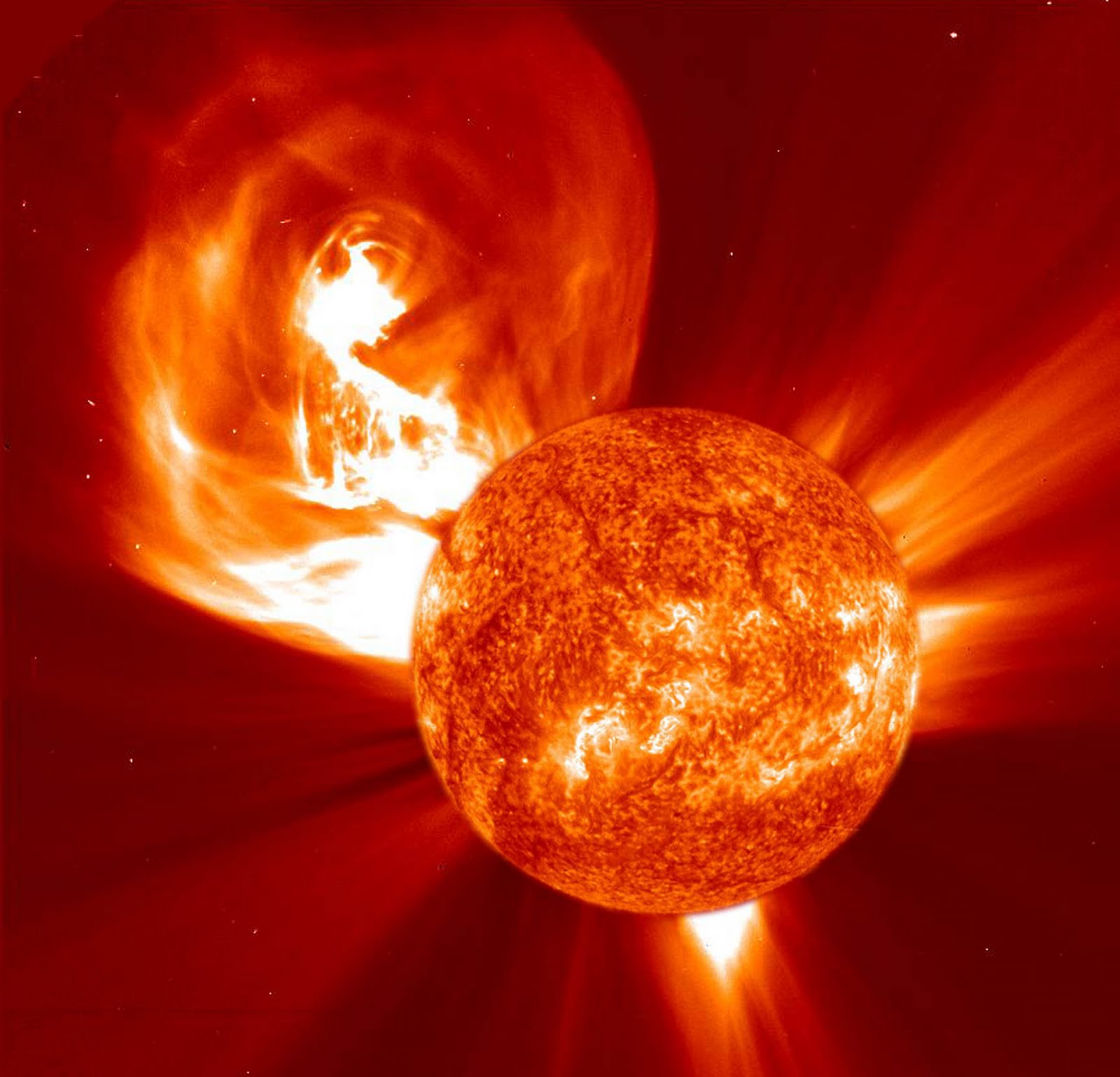
Back in June I blogged about the potential dangers arising from space storms that could spawn devastating solar flares. This is no joke, nor is it part of the laughable (but conveniently co-incidental) 2012 doomsday nonsense. There's actual science involved here; NASA issued a solar storm warning back in 2006 in which it predicted that the worst of it could come sometime between 2011 and 2012. Last year they slightly downgraded their warning, while extending their forecast to 2013—May 2013 to be exact, which sounds eerily specific.

According to NASA, we are currently in a solar maximum period. These cycles are capable of creating space storms—what are known as "Carrington Events," named after astronomer Richard Carrington who witnessed a particularly nasty solar flare back in 1859. The flare he documented resulted in electrified transmission cables, fires in telegraph offices, and Northern Lights so bright that people could read newspapers by their red and green glow...in Mexico.

If this is what happened in 1859, imagine what would happen today. Well, we're starting to have some idea—and the news is pretty bad.

A recent report by the National Academy of Sciences found that if a similar storm occurred today, it could cause $1 to 2 trillion in damages to society's high-tech infrastructure and require four to ten years for complete recovery. It could damage everything from emergency services’ systems, hospital equipment, banking systems and air traffic control devices, through to everyday items such as home computers, iPods and GPS's. Because of our heavy reliance on electronic devices, which are sensitive to magnetic energy, the storm could leave a multi-billion dollar damage bill and cataclysmic-scale problems for governments.

Worse than this, however, would be the potential length of blackouts. According to a Metatech Corporation study, an event like the 1921 geomagnetic storm would result in large-scale blackouts affecting more than 130 million people and would expose more than 350 transformers to the risk of permanent damage. It could take months—if not years—to put everybody back on the grid.

For more reading, I recommend the NASA report, "Severe Space Weather Events--Understanding Societal and Economic Impacts: A Workshop Report" (2008). Excerpt:
Modern society depends heavily on a variety of technologies that are susceptible to the extremes of space weather—severe disturbances of the upper atmosphere and of the near-Earth space environment that are driven by the magnetic activity of the Sun. Strong auroral currents can disrupt and damage modern electric power grids and may contribute to the corrosion of oil and gas pipelines. Magnetic storm-driven ionospheric density disturbances interfere with high-frequency (HF) radio communications and navigation signals from Global Positioning System (GPS) satellites, while polar cap absorption (PCA) events can degrade—and, during severe events, completely black out—HF communications along transpolar aviation routes, requiring aircraft flying these routes to be diverted to lower latitudes. Exposure of spacecraft to energetic particles during solar energetic particle events and radiation belt enhancements can cause temporary operational anomalies, damage critical electronics, degrade solar arrays, and blind optical systems such as imagers and star trackers.

The effects of space weather on modern technological systems are well documented in both the technical literature and popular accounts. Most often cited perhaps is the collapse within 90 seconds of northeastern Canada’s Hydro-Quebec power grid during the great geomagnetic storm of March 1989, which left millions of people without electricity for up to 9 hours. This event exemplifies the dramatic impact that extreme space weather can have on a technology upon which modern society in all of its manifold and interconnected activities and functions critically depends.

Nearly two decades have passed since the March 1989 event. During that time, awareness of the risks of extreme space weather has increased among the affected industries, mitigation strategies have been developed, new sources of data have become available (e.g., the upstream solar wind measurements from the Advanced Composition Explorer), new models of the space environment have been created, and a national space weather infrastructure has evolved to provide data, alerts, and forecasts to an increasing number of users.

Now, 20 years later and approaching a new interval of increased solar activity, how well equipped are we to manage the effects of space weather? Have recent technological developments made our critical technologies more or less vulnerable? How well do we understand the broader societal and economic impacts of extreme space weather events? Are our institutions prepared to cope with the effects of a “space weather Katrina,” a rare, but according to the historical record, not inconceivable eventuality?
Read more.

Saturday, September 4, 2010

Anissimov: Beware botulinum and EMP attacks

Michael Anissimov of Accelerating Future is feeling a bit doomy these days—and for good reason. He argues that we're collectively understating and underreporting non-conventional but thoroughly viable catastrophic risks, including the deliberate spread of botulinum toxin and an EMP attack.

On the latter risk, Anissimov writes:
If an EMP attack came, cars and trucks would just stop. Factories, controlled by computers, would stop. Molten steel on the assembly line would cool and solidify in place due to failure of the heating elements. The vast majority of tractors, combines, and other heavy machinery would become useless. Transformers and other electrical elements, large and small, would be fried. The largest transformers have to be ordered from China and are generally ordered with a year of lead time.

An effective EMP attack on the US would cause tens of trillions of dollars of damage. Cities would run out of food in a few days. The US grain stockpile only has about a million bushels of wheat. Wheat is the only common grain with enough nutrients to sustain someone on an all-grain diet. A bushel is only 60 pounds, and someone needs about a pound of wheat a day to avoid hunger pangs. Ideally two pounds if you are doing manual labor. 60 million man-days of food is not a lot. The population of the United States is 300 million. That means our grain stockpiles are enough food for everyone to eat a fifth of a pound and then they’re gone.
By the way, if you're particularly paranoid about this, you can always convert your house into a Faraday Cage. I'm just not sure how useful all your electronics will be given that everyone else's will be fried.

And in regards to the botulinum risk, he writes, "99.9% of the population will dismiss [it] as not a big deal, due to wishful thinking. It’s all just words on the page, until people start dying."

Wednesday, August 4, 2010

Martin Rees on our posthuman future—and avoiding catastophe

Thomas McCabe, writing for Kurzweil AI, recently reported on Sir Martin Rees's address to the Long Now Foundation. McCabe notes,
Over the truly long term, our posthuman descendants will become — not just second-generation intelligences — but thousand-generation or million-generation intelligences. He quoted Darwin on how no species can pass its likeness into the distant future unaltered; in a billion years of biological evolution, we’ve gone from bugs to humans, and technological evolution is a lot faster than biological. Our distant descendants will be not just strange, but completely alien to us.
According to Rees, we not only have unprecedented opportunity, but unprecedented responsibility. If the new technologies we build have a high chance of causing civilization-wide catastrophe for the first time in history, we are responsible for actively preventing that from happening, not just trying to predict it or understand it.

Link.

Saturday, March 29, 2008

Large Hadron Collider accused of being an existential threat

Walter L. Wagner and Luis Sancho are pursuing a lawsuit in a U.S. federal court to prevent Geneva's Large Hadron Collider from being switched on later this summer.

They're afraid that the new giant particle accelerator could destroy the entire planet.

That is, without trying to over-state the obvious, a rather extraordinary claim; it doesn't get much more serious than that.

Wagner and Sancho argue that scientists at the European Center for Nuclear Research, or CERN, have played down the chances that the collider could produce a tiny black hole or a strangelet that would convert Earth to a shrunken mass of strange matter.

They also claim that CERN has failed to provide an environmental impact statement as required under the National Environmental Policy Act.

This case illustrates a disturbing new trend -- one that started with the development of the atomic bomb: we are increasingly coming into the possession of technologies that could cause the complete extinction of the human species.

Or, at the very least, technologies that we think might destroy us.

Memories of the Manhattan Project

We don't know for certain that the collider will create a black hole or cause some other unpredictable disaster.

But we suspect that it might. Thus, it has to be considered an existential risk.

This is now the second time this has happened to us.

Back during the early days of the Manhattan Project, a number of scientists voiced their concern that the explosion might start a runaway chain-reaction by "igniting" the atmosphere. It was decided that the threat was very low and, as we all know, the United States went ahead and detonated the first bomb on July 16, 1945.

But for a brief moment 63 years ago, some concerned observers held their breath and nervously watched at the bomb lit-up the New Mexico sky.

And now we have a new contender for the perceived existential threat de jour.

Let science be our guide

Is the Hadron Collider an existential risk? Well, based on our current understanding of physics, we have to conclude that there is a non-zero probability that the collider will act in a way that could destroy the planet.

Just how non-zero is the next big question.

Three years ago, Max Tegmark and Nick Bostrom wrote a piece for Nature in which they took a stab at the question. They warned that humanity has been lulled into a false sense of security and that "the fact that the Earth has survived for so long does not necessarily mean that such disasters are unlikely, because observers are, by definition, in places that have avoided destruction."

To reach an answer, they combined physics, philosophy, probability theory (and most assuredly a hefty dose of wild-ass guessing) and concluded that a civilization destroys itself by a particle accelerator experiment once every billion years.

Admittedly, one in a billion seems excruciatingly improbable.

So let's have some fun and smash those particles together at extreme velocities.

But I have to wonder: what if they had concluded a one in a million chance? Is that sufficiently low? Remember, we're talking about the fate of all human life here.

What about one in a hundred thousand?

At what probability point do we call it all off?

How will we ever be able to agree? And would our conclusions cause us to become cripplingly risk averse?

I have no good answers to these questions, suffice to say that we need to continually develop our scientific sensibilities so that we can engage in risk assessment with facts instead of conjectures and hysteria.

The new normal

Moving forward, we can expect to see the sorts of objections being made by Wagner and Sancho become more frequent. Today's it's particle accelerator experiments. Tomorrow it will be molecular nanotechnology. The day after tomorrow it will be artificial intelligence.

And then there are all those things we haven't even thought of yet.

The trick for human civilization will be to figure out how to assess tangible threats, determine level of risk, and devise steps on how to take action.

But it doesn't end there. Inevitably, we will develop technologies that have great humanitarian potential, but are like double-edged swords. Molecular nanotechnology certainly comes to mind.

Consequently, we also have to figure out how to manage our possession of an ever-increasing arsenal of doomsday weapons.

It will be a juggling act where one single mistake will mean the end of all human life.

Not a good proposition.